

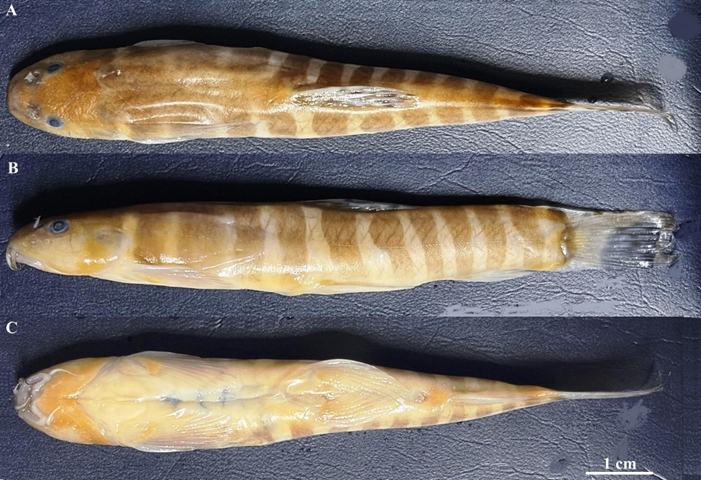
Bhimtal, Uttarakhand: Scientists from the ICAR–Central Institute of Coldwater Fisheries Research (ICAR-CICFR), Bhimtal, have identified a new species (Figure 1) of rock loach, Mustura kalsiensis sp. nov., from the Kalsa Stream, a tributary of the Ganga River basin in the Indian Himalaya, Uttarakhand. The discovery represents an important contribution to the understanding of the rich and largely underexplored ichthyofaunal diversity of Himalayan mountain streams.
The newly identified species, Mustura kalsiensis, belongs to the family Nemacheilidae, commonly known as stone loaches or rock loaches. The species was collected from Kalsa Stream, a montane stream within the Ganga River basin of Uttarakhand. The discovery is particularly significant because this is the first report of any species of the genus Mustura from Uttarakhand. Detailed morphological examination revealed a unique combination of characters distinguishing Mustura kalsiensis from its congeners. One of the most striking diagnostic features is the presence of three rows of elliptical spots on the caudal peduncle, forming a distinctive “W”-shaped pattern. The species possesses a complete lateral line with 96–120 pored scales and 17–21 conical-shaped suborbital sensory papillae. The taxonomic investigation was supported by molecular analysis based on a 655-base-pair fragment of the mitochondrial cytochrome c oxidase subunit I (coxI) gene, a widely used DNA barcode for fish species identification.
Mustura kalsiensis sp. nov., a newly identified species of rock loach from Kalsa Stream, a tributary of the Ganga River basin in Uttarakhand, Indian Himalaya. (A) Dorsal view, (B) lateral view and (C) ventral view
The discovery of Mustura kalsiensis reinforces the view that the Himalayan coldwater aquatic ecosystems continue to hold considerable undocumented biodiversity. The discovery also emphasizes the importance of systematic exploration of montane streams, tributaries and headwater ecosystems for geographically restricted and evolutionarily distinct freshwater fish lineages. The finding of Mustura kalsiensis is an important milestone in documenting the remarkable yet incompletely explored fish diversity of the Himalayan coldwater ecosystems. Such discoveries demonstrate the scientific value of sustained biodiversity surveys and systematic research in mountain streams and tributaries.
The investigation was led by Dr Neetu Shahi, ICAR National Fellow, along with her team comprising Dr Debajit Sarma, Principal Scientist, Mr Sumanta Kumar Mallik, Scientist, Dr Parvaiz Ahmed Ganie, Scientist and Mr Bhupendra Singh, Research Scholar at ICAR-CICFR, Bhimtal. The work was supported by the Indian Council of Agricultural Research (ICAR) under project AQ 18D, “Mahseer Network Project Species and stock validation of mahseer species of genus Tor and Neolissochilus from the western and eastern Himalayan region of India for its propagation and conservation.”